
Aerospace
Composite solutions for load-bearing structures in aviation
Lightweight. Safe. Powerful.
In aircraft construction, every gram counts. Load-bearing structures require materials with maximum performance - without compromising on safety or process capability. This is why SAERTEX develops textile carbon fabrics that are specially designed for RTM and infusion processes.
As the world's leading manufacturer of multiaxial fabrics for the aerospace industry, we supply projects ranging from commercial aircraft to eVTOLs. Our carbon fiber solutions are used in primary and secondary structural components - including stringers, cladding parts, pressure caps and entire wings.
Our approach: certified quality, reliable process integration and proven performance on a series scale.
Your contact person
Our strengths in aviation
Strong consulting expertise and global supply chains
As an independent player in fiber procurement and with strong supplier networks, our team of specialists for the aerospace industry offers tailor-made solutions and maximum availability of the required materials.
Tailormade textiles for maximum process reliability
With our automated Smart Detect Control system, we detect even the smallest deviations from high-end specifications - directly inside the fabric and during production. This guarantees the highest quality and ensures process reliability in your further processing.
Market leader in aviation - certified according to EN9100
As the world's largest manufacturer of multiaxial fabrics for the aviation industry, we deliver experience and capacity from prototype to series production. With EN9100-certified processes, we guarantee quality, traceability and reliable deliveries for safety-critical applications.
Application in focus
From wing structures to turbines: our carbon fiber-reinforced textiles reduce weight while improving stability, efficiency and safety in aviation. They are used in a wide range of structures - including fuselage segments, cladding parts, stringers and engine cowlings.
Wing structures
Fiber composites make wings lighter and more stable - from ribs and spars to movable elements such as flaps or spoilers. They increase aerodynamics and efficiency and thus contribute to greater range and lower fuel consumption.
Turbines
In engine cowlings and turbine components, carbon composites offer temperature resistance, vibration damping and weight reduction - for more power with less fuel consumption.
Areas of application in aviation
Helicopter
Rotor blades and structural parts made of carbon composites offer stability, lightweight construction and vibration reduction - for safe, efficient and high-performance flights.
eVTOLs & drones
Ultralight fiber composite structures guarantee operation range, agility and robustness - the basis for sustainable urban air mobility and smart aircraft.
Rockets
Carbon fiber-reinforced plastics combine extreme strength with minimal weight and high temperature resistance - for maximum performance and reliability in space.
Defense
Carbon and aramid fiber-reinforced textiles combine high mechanical stability with excellent energy absorption and thus offer reliable safety in use.
Reinforcing materials for aviation
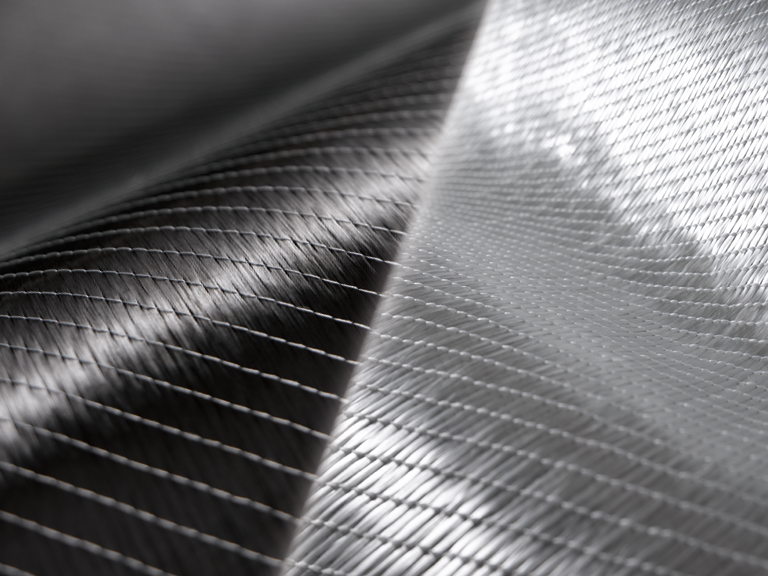
For aerospace applications, SAERTEX develops multiaxial carbon fabrics that meet the highest quality requirements. They combine low weight, maximum stability and reliable processing - the basis for reliable structural components. For many applications, they offer an economically and technically viable alternative to classic prepregs.
In addition, SAERTEX offers customized CFRP solutions for complex components with special design and functional requirements.
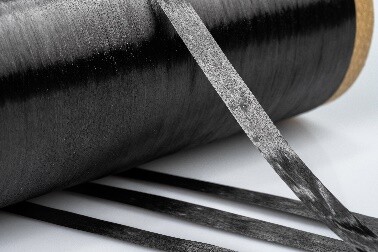
Unidirectional carbon fiber tapes from 6 mm width ensure maximum dimensional accuracy and improved fiber bonding through powder coating. Ideal for automated production of complex geometries, with minimum waste and maximum material efficiency.
Multiaxial and unidirectional fabrics are versatile reinforcing materials for fiber-reinforced plastics. They are used in many industries wherever lightweight yet resilient components are required.
Powder coating of fabrics refers to a process in which powdered polymers are applied to the textile structure. This is an important processing step in automated fiber composite technology, especially in the manufacture of preforms or semi-finished products.
Individual material development
for
High performance in aviation
You are currently viewing a placeholder content from YouTube. To access the actual content, click the button below. Please note that doing so will share data with third-party providers.
More InformationAutomated & AI-supported quality INSPECTION
To ensure the quality of our carbon fiber fabrics, SAERTEX relies on the Smart Detect Control System. This AI-based technology allows us to look inside the fabric and detect potential gaps, ondulations or other deviations from high-end specifications already during production.
This takes the quality inspection of all layers in the multiaxial fabric to a new level: defects that remain invisible to the human eye are reliably detected. This increases process reliability, component reliability and safety in the aerospace industry.
The process is characterized by:
- Consistent and automated transparency and traceability
- Non-destructive and digital processes in real time
- Safety for your production process
In use worldwide
Proven in aviation: Our reinforcement materials are used in numerous aerospace programs - from wide-body aircraft such as the Airbus A380 to launch vehicles such as the Ariane 6.
Thanks to many years of cooperation with well-known OEMs and Tier 1 suppliers, our fabrics are now an integral part of many applications in which weight, performance and reliability are crucial.
You are currently viewing a placeholder content from YouTube. To access the actual content, click the button below. Please note that doing so will share data with third-party providers.
More InformationSustainability in aviation
Also in aviation, we have a responsibility to promote sustainable solutions. SAERTEX is continuously working to reduce the environmental impact of our production - from the choice of materials to our processes.
We are assessed according to EcoVadis and consistently align our measures with recognized sustainability standards. These include the avoidance of waste, the use of recycled materials and initiatives for an optimized circular economy.
Our goal: lightweight products that are not only high-performance, but also contribute to more sustainable aviation.
Frequently asked questions
Lorem ipsum dolor sit amet, consetetur sadipscing elitr, sed diam nonumy eirmod tempor invidunt ut labore et dolore magna aliquyam erat, sed diam voluptua. At vero eos et accusam et justo duo dolores et ea rebum.
1st question
At vero eos et accusam et justo duo dolores et ea rebum. Stet clita kasd gubergren, no sea takimata sanctus est Lorem ipsum dolor sit amet.
2nd question
At vero eos et accusam et justo duo dolores et ea rebum. Stet clita kasd gubergren, no sea takimata sanctus est Lorem ipsum dolor sit amet.
3rd question
At vero eos et accusam et justo duo dolores et ea rebum. Stet clita kasd gubergren, no sea takimata sanctus est Lorem ipsum dolor sit amet.
Frequently asked questions
Lightweight. Safe. Powerful. In aviation, every gram counts - our materials combine minimum weight with maximum strength. The FAQ shows typical applications, material advantages and challenges in aviation.
How do I find the right material for my sports product?
Requirements such as weight, strength, cost, appearance and production volume are decisive. An experienced partner can advise on design and optimization. Please contact
What advantages do fiber composite materials offer over metal or plastic?
Fiber composites are significantly lighter than metals, while at the same time being more dimensionally stable and much more durable than many plastics. As a result, they improve the performance of sports equipment and enable new designs.
What are fiber composites - and why are they used in sports?
Fiber composites consist of reinforcing fibers (e.g. glass, carbon or natural fibers) and a matrix, usually resin. They offer high strength at low weight - ideal for sports equipment,
You are currently viewing a placeholder content from Vimeo. To access the actual content, click the button below. Please note that doing so will share data with third-party providers.
More InformationYou are currently viewing a placeholder content from YouTube. To access the actual content, click the button below. Please note that doing so will share data with third-party providers.
More Information